Crushing Arm Operating Specifications and Application Scenarios
Source:Shandong Lutong Construction Machinery Co., Ltd. Date:2026-04-24
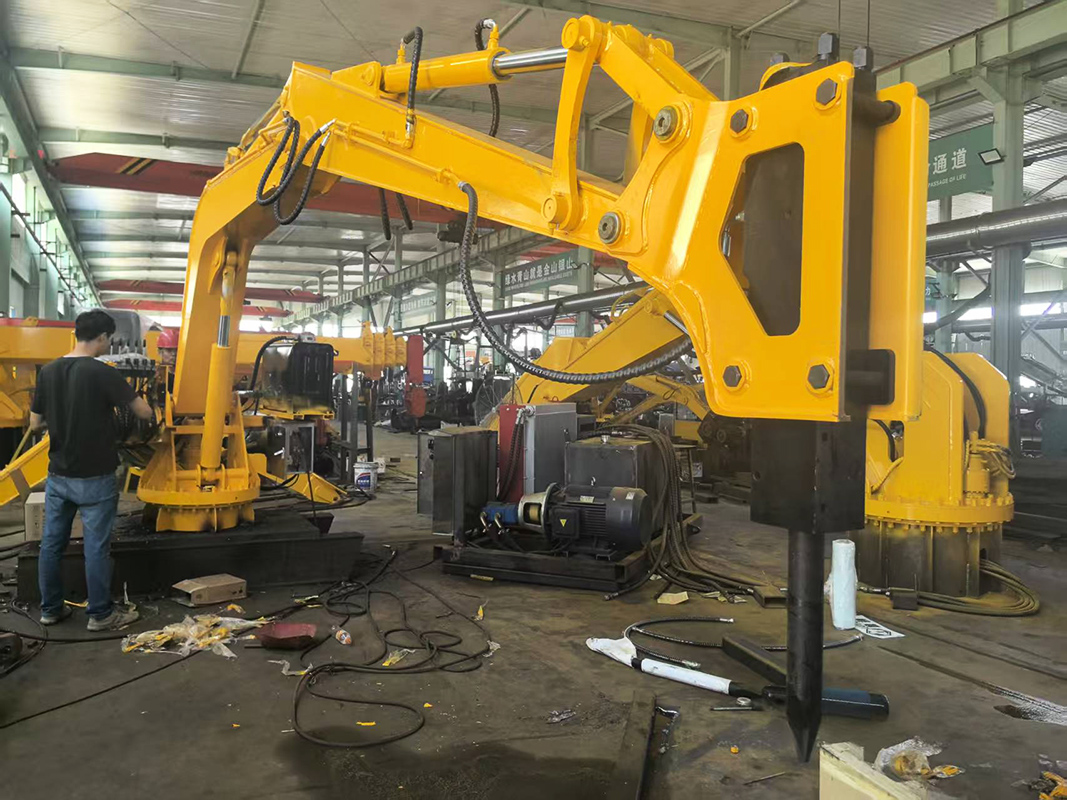
As core equipment for high-risk operations, crushing arms require standardized operation to ensure personnel safety and stable equipment performance. Please refer to the following safety guidelines.
I. Six Major Operating Specifications
Operators must receive professional training and hold valid certificates, be proficient in remote control procedures. Unauthorized operation without certification is strictly prohibited.
The crushing chisel shall be vertically pressed against the striking surface. Idle striking and inclined operation are forbidden. Continuous impact shall not exceed 30 seconds each time.
Keep a clear field of vision during remote operation. Assign dedicated personnel for on-site guidance when obstacles exist in the working area.
For operation indoors or in enclosed spaces, electric mode is recommended with ventilation equipment equipped to prevent exhaust gas accumulation.
Immediately press the emergency stop button and cut off the power supply to inspect faults if abnormal noise, vibration or hydraulic leakage occurs during operation.
After work, retract the arm and chisel, clean up gravel and dust on the equipment surface, inspect key components and keep operational records.
II. Five Absolute Prohibitions
Operation within 15 meters of high-voltage power lines is strictly prohibited to prevent electric shock hazards.
Overload and over-range operation are forbidden. The single breaking load shall not exceed 80% of the rated value.
Do not operate under severe conditions such as strong winds above Grade 6, rainy days, and night work without sufficient lighting.
It is forbidden to stand or place obstacles within the moving range of the mechanical arm.
Unauthorized equipment modification (such as lengthening the arm or using non-original chisels) is prohibited to prevent accidents caused by insufficient structural strength.
III. Solutions for Five Core Application Scenarios
Mining & Obstacle Removal
Pain points: Massive ore blocks block the chute in open-pit mines, and manual removal brings high safety risks.Solution: Adopt 5–10 ton hybrid models equipped with high-strength crushing arms. Remotely clear bulk ore with a daily processing capacity of 1,800 tons, raising working efficiency by 25% compared with traditional equipment.
Urban Building Demolition
Pain points: Traditional blasting for dilapidated buildings in old urban areas causes heavy dust and strong vibration, threatening surrounding buildings.Solution: 3–5 ton fully electric models fitted with hydraulic shears realize clean separation of steel bars and concrete with a 98% recycling rate and 70% less dust emission.
Emergency Rescue & Breaking
Pain points: Narrow space in post-earthquake and traffic accident ruins with high risk of secondary collapse.Solution: Crawler-type crushing robotic arms can cross rubble and climb stairs. Equipped with spreaders and hydraulic cutters, they quickly open rescue passages and avoid casualties of rescuers.
Metallurgical & Chemical Equipment Maintenance
Pain points: High temperature and toxic gas inside blast furnaces and reactors greatly threaten maintenance workers.Solution: Fully electric remote-controlled units conduct internal breaking and cleaning. Operators work remotely in safe areas, boosting working efficiency three times.
Non-blasting Earth & Rock Construction
Pain points: Hard rock excavation in blast-restricted areas suffers from low breaking efficiency with conventional machinery.Solution: 5–8 ton models with thickened boom design deliver greatly enhanced digging force. Suitable for rocks with a Protodyakonov coefficient f<8, they achieve efficient non-blasting breaking and cut maintenance costs by 50%.
Prev Article:Next Article: